

For millions of people like remote workers, smart home owners and small shop operators and end users, picking the right mini UPS used to feel like a guessing game. Many users have bought compact backup units only to find they die after 30 minutes of an outage, or paid a premium for an oversized model that never delivers the promised runtime.Today, as public awareness of diverse Mini UPS Battery Types continues to grow, WGP mini UPS has officially launched its new 103A/B/C series — a purpose-built product line designed to eliminate that confusion entirely by directly linking real-world Mini UPS battery capacity, verified Mini UPS backup time, physical footprint and transparent pricing to the exact needs of different user groups.
This series builds on the market’s most trusted, field-tested battery chemistries, centered around the proven, widely adopted 18650 Battery Mini UPS configuration that defines a reliable, long life Mini UPS for everyday use. Every model in the 103 family is built around strict, user-centric design principles: no overstated runtime claims, no unnecessarily bulky casings, no hidden features that add no real value for everyday use. At its core, the 103A/B/C lineup answers the three most common, unspoken questions every buyer asks before purchasing a backup power unit: how long will it actually run my devices, will it fit on my desk or in my cabinet, and is it really worth the money I am paying.
The 103A model is built as a high-performance 18650 Battery Mini UPS, optimized for users who only need basic, reliable battery backup for WiFi router during short, frequent grid flickers and minor power disruptions. Equipped with grade-A 18650 lithium-ion cells that pass 7 layers of safety testing, it comes as a over 10000mAh Mini UPS with verified, usable capacity that keeps a standard 12V home router running for 6 to 8 full hours on a single full charge. Its palm-sized body measures only 116*73*24mm, so it slips easily behind a router, inside a narrow media cabinet or even on a crowded desk edge without taking up extra workspace. Priced at an accessible entry point, it is the ideal pick for casual home users who want solid outage protection without overspending, and it still delivers far more consistent, stable performance than generic unbranded mini UPS units flooding the market. 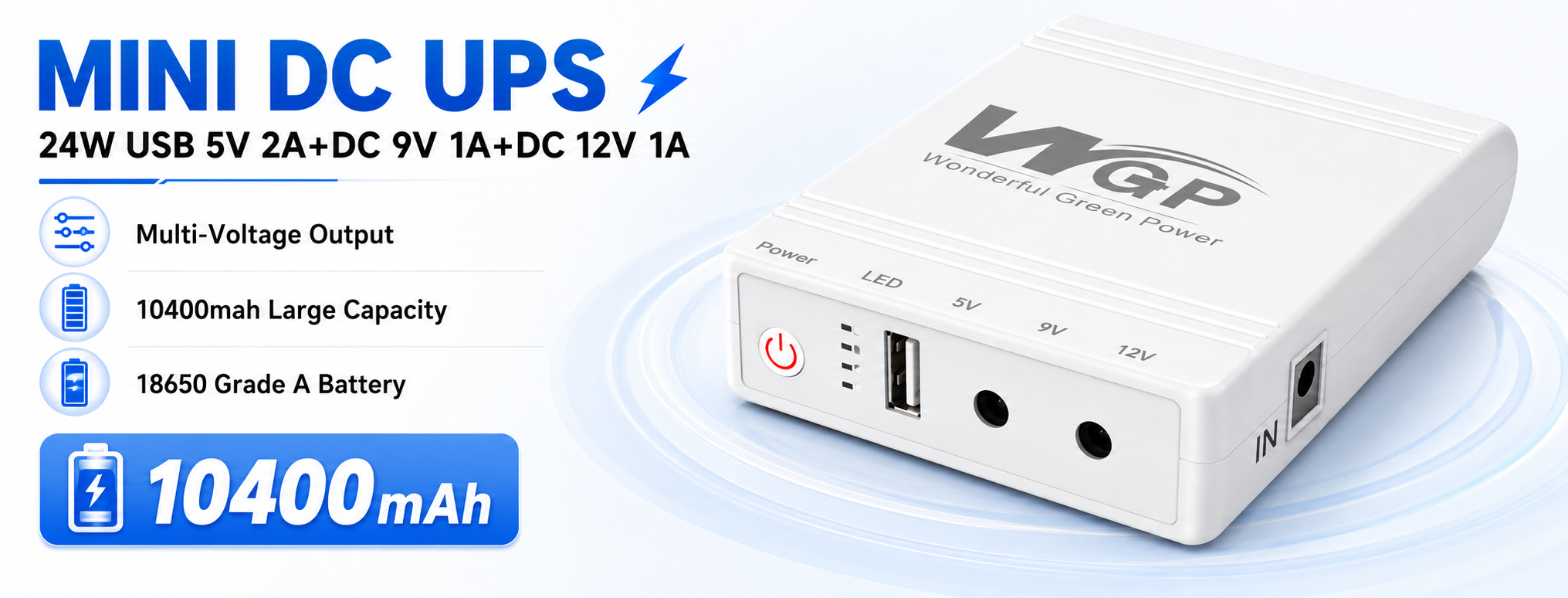
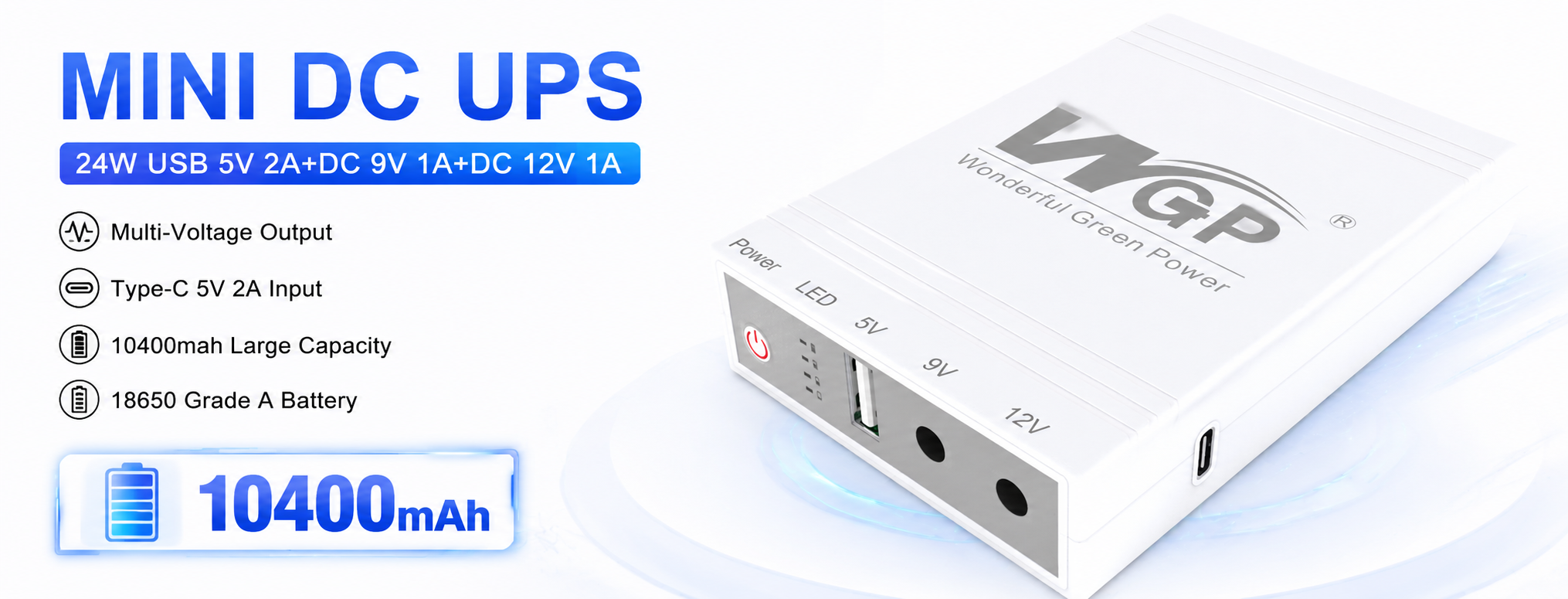
Moving up the lineup, the 103B stands out as the only model in the segment with a full-featured Type-C input port, making it far easier to top up from common phone chargers, power banks and adapters that most users already own. As users now understand from the expanding public knowledge of Mini UPS battery types. It is also a highly reliable Mini UPS for WiFi router that can easily handle extended outages that would drain smaller, lower-capacity backup units.
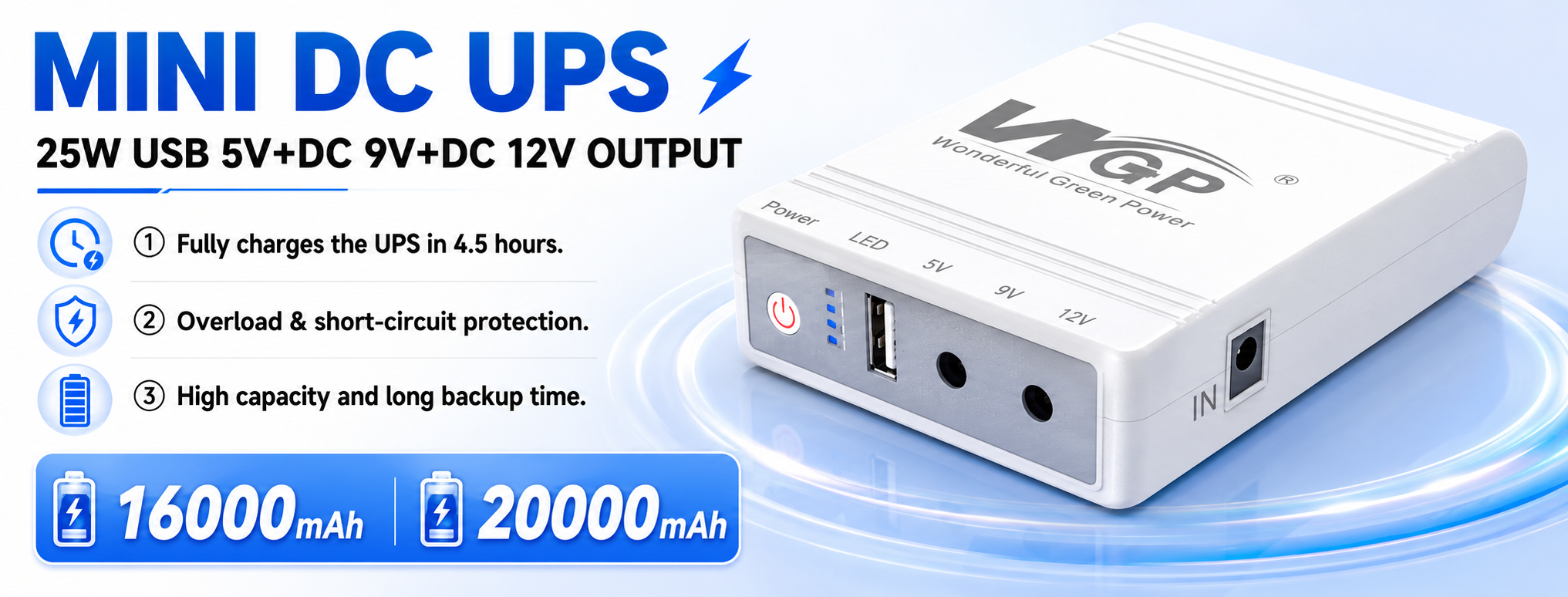
The top-tier 103C model is the high-capacity flagship built for multi-device, long-duration outage protection. As a full 20000mAh Mini UPS, it is designed specifically to deliver stable CCTV UPS battery backup for home and small business surveillance systems, alongside continuous power for network switches and multiple connected smart devices. Even with its significantly boosted total capacity, the WGP engineering team kept its overall size compact enough to mount on a standard wall near the network cabinet, completely avoiding the bulky, space-wasting design flaws common in most high-capacity mini UPS units on the market. For small cafes, co-working spaces and small retail shops that need to keep POS terminals, security cameras and full network switches online through extended multi-hour outages, the 103C delivers the consistent, long-lasting runtime that cheaper, smaller models simply cannot match.
To help users pick the right model without technical confusion or misleading marketing, WGP has released a simple 3-step selection guide alongside the new product launch, paired with a public Mini UPS battery capacity comparison chart that lists every model’s real usable capacity, actual Mini UPS backup time for common devices, and exact physical dimensions. The guide advises buyers to first calculate exactly how many hours of backup runtime they actually need for their most critical devices; second, confirm the exact power draw and voltage requirements of your connected load to avoid overbuying unnecessary capacity; third, measure the available space near your router or network cabinet to confirm the maximum acceptable size for your new unit.
Post time: Aug-14-2026


