

If you have ever faced sudden power outages that cut off your internet halfway through a work call or a movie night, you must have thought about getting a small power backup to keep your network running. Many people pick a random backup device just by looking at its battery size on the label, but this often leads to disappointment when it runs out of power much faster than you expected. For regular home users, small office owners and local internet service teams, knowing exactly how long your backup will last can help you avoid both unexpected service drops and wasting money on over-sized products you do not actually need.
When you first start to pick a backup device for your network setup, the first term you will run into a lot is Mini UPS battery backup time. This number tells you how long your key network devices can keep running after the main power cuts off. For most daily users, this running time does not need to be super long, but it has to be enough for you to finish an ongoing important task, or cover the common 2 to 4 hours long local power outage that happens a lot in many areas. If you only have one small ONT device at home, even a compact entry-level Mini UPS can give you enough runtime for normal use, without taking too much space on your desk or costing too much.
To get this number right, you do not need fancy professional tools. The core step you have to master is Mini UPS backup time calculation. The whole process uses very simple math that everyone can do at home. The basic formula you can use is:
Backup Time (Hours) = Total Battery Energy (Wh) × UPS Efficiency ÷ Total Load Power (W).

If you want a quick rough estimate, you can even skip the efficiency part first, just divide the total Wh of the battery by the total watt of your devices. If your UPS only marks its capacity in mAh, you can turn it into Wh by multiplying the mAh number with its working voltage, then divide the result by 1000. For example, a 10400mAh 3.7V battery has a total energy of 38.48Wh, this makes it super easy to compare different devices of different specs.
If you are using a separate wireless router at home, a proper Mini UPS for router is far better than those big traditional AC UPS units you may see for desktop computers. Those old-style AC UPS have to turn battery DC power into AC power first, then your router’s power adapter turns that AC back into DC again, this double conversion wastes 20% to 30% of the total stored energy. A dedicated DC Mini UPS outputs the correct DC voltage directly, it cuts out all those extra conversion steps, hits 90% to 95% working efficiency, and gives you more than 30% longer runtime with the same battery size. Even a 38.48Wh Mini UPS can easily power a standard 9.6W(running full load) home router for about 4 hours during a blackout.
If your home network setup has both the fiber ONT device that connects to the ISP line and your Wi-Fi router that spreads internet signal to all your phones and laptops, you do not need to buy two separate backup units. A good router and ONT UPS can power both devices at the same time with zero transfer time, so your internet will not even blink when the main power fails. Most common home ONT and router setups have a total power load between 6W to 10W, you can pick a Mini UPS with 49.95Wh battery to get 5 hours or more of continuous runtime, which is more than enough for most unexpected outages you will meet in daily life.
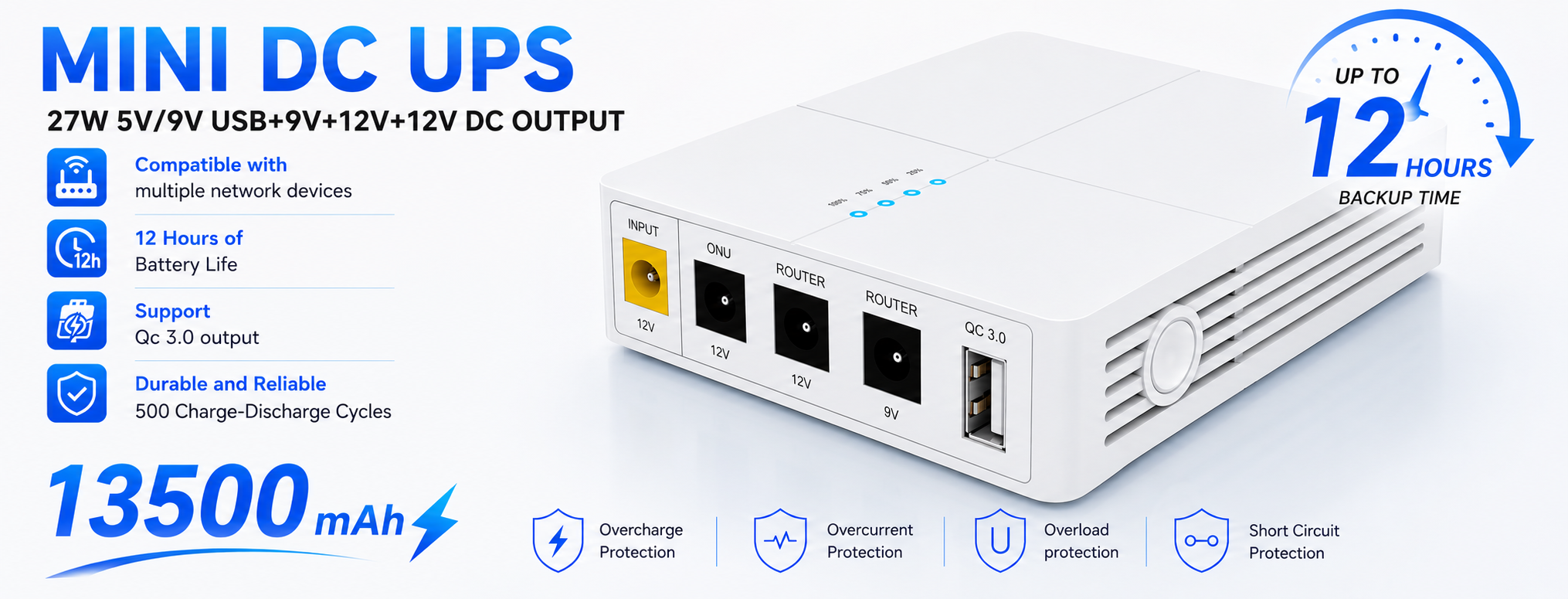
One small tip to remember: the theoretical number you get from the calculation is usually 10% to 20% higher than the real runtime you get in actual use. This is totally normal, because lithium batteries will lose a little capacity after hundreds of charge cycles, low surrounding temperature can also drag down the battery’s discharge performance. Always leave a small safety buffer when you pick your UPS model, this will make sure you never get stuck with no power in the middle of an outage. With these simple steps, anyone can pick the right backup power to keep their network running reliably all the time.
Post time: Sep-10-2026


