

What is a LiFePO₄ Mini UPS?
A LiFePO4 Mini UPS, also referred to as Lithium Iron Phosphate UPS, is a compact, plug-and-play uninterruptible power supply designed specifically for low-voltage smart and network devices. Unlike bulky, high-maintenance traditional UPS systems and low-cost lead-acid mini power backups, the Mini UPS with LiFePO4 battery delivers optimized standby power for modern homes and small businesses. As a reliable WiFi router backup battery, it solves one of the most common and disruptive daily issues: sudden power outages that cut home internet, interrupt remote work meetings, disable smart home devices, and suspend 24/7 CCTV monitoring. For users who rely on stable network and surveillance operation, this compact power backup has become an essential, cost-effective power safety solution.
| Lithium Iron Phosphate (LiFePO₄) vs. Standard Lithium Batteries vs. Lead-Acid Batteries | |||
| Comparison items | LiFePO₄ | 18650/NCM | Lead-acid battery |
| Battery type | A type of lithium-ion battery | Lithium-ion batteries | Traditional Lead-Acid Batteries |
| Cathode material | Lithium Iron Phosphate (LiFePO₄) | Ternary lithium (NCM/NCA), lithium cobalt oxide, etc. | Lead plates + sulfuric acid electrolyte |
| Safety performance | ⭐⭐⭐⭐⭐ Extremely high; strong thermal stability; low risk of thermal runaway | ⭐⭐⭐⭐ Relatively high, though risks increase under high temperatures or overcharging | ⭐⭐⭐ Average; risk of leakage and corrosion |
| Cycle life | 2,000–5,000 cycles | 500–1,000 cycles | 300–500 cycles |
| Service life | 5–10 years | 2–3 years | 1–3 years |
| Battery stability | Stable voltage plateau; excellent long-term output performance | Good output stability, but capacity degrades relatively quickly | Significant voltage drop during discharge |
| Energy density | Moderate (approx. 90–160 Wh/kg) | High (approx. 150–250 Wh/kg) | Low (approx. 30–50 Wh/kg) |
| Weight | Lightweight | Lightest | Heavy |
| Volume | Moderate | Compact | Bulky |
| Charging speed | Fast; supports high-rate charging | Relatively fast | Slow |
| Discharge capability | Excellent; supports stable high-rate output | Relatively good | Weak |
| High-temperature performance | Excellent; withstands higher-temperature environments | Average; high temperatures affect lifespan | Poor |
| Low-temperature performance | Good; though low-temperature charging requires protection | Average | Poor |
| Self-discharge rate | Low | Moderate | High |
| Environmental friendliness | Free of heavy metals like cobalt and nickel; more eco-friendly | Contains some cobalt and nickel materials | Contains lead; significant environmental impact |
| Maintenance requirements | Virtually maintenance-free | Virtually maintenance-free | Requires regular maintenance |
| Cost | Relatively high | Moderate | Low |
| Suitable applications | Mini UPS, home energy storage, solar energy storage, backup power for telecommunications | Consumer electronics, electric equipment, small UPS units | Automobiles, power backup, telecommunications equipment |
Key advantages of LiFePO₄:
The biggest upgrade of LiFePO4 mini UPS lies in its battery durability and long-term usability, which solves the core pain points of traditional models. Most entry-level mini UPS equipped with lead-acid or ordinary ternary lithium batteries only achieves 500 to 1000 charge cycles. After 1–2 years of daily standby use, they suffer obvious capacity attenuation, overheating and even bulging, requiring frequent replacements and raising hidden maintenance costs. In comparison, premium LiFePO4 32140 cells adopted by high-end mini UPS support up to 4000 deep charge-discharge cycles, boasting 4–6 times longer service life and maintaining stable working performance for years of continuous use.
Comprehensive safety upgrades; capable of 24/7 unattended operation:
Safety is another irreplaceable advantage of the WGP LiFePO4 Mini UPS. Built with a complete intelligent protection system, it effectively resists overcurrent, overcharge, over-discharge and short-circuit risks. Featuring ultra-stable chemical structure and excellent high-temperature resistance, it avoids thermal runaway hazards. It can be safely installed in narrow enclosed spaces such as network cabinets and wall-mounted monitoring boxes, supporting 24/7 unattended operation with zero safety risks, which is far more reliable than ordinary lithium and lead-acid products.
WGP Optima 303 — New Multifunctional LiFePO4 Mini UPS:
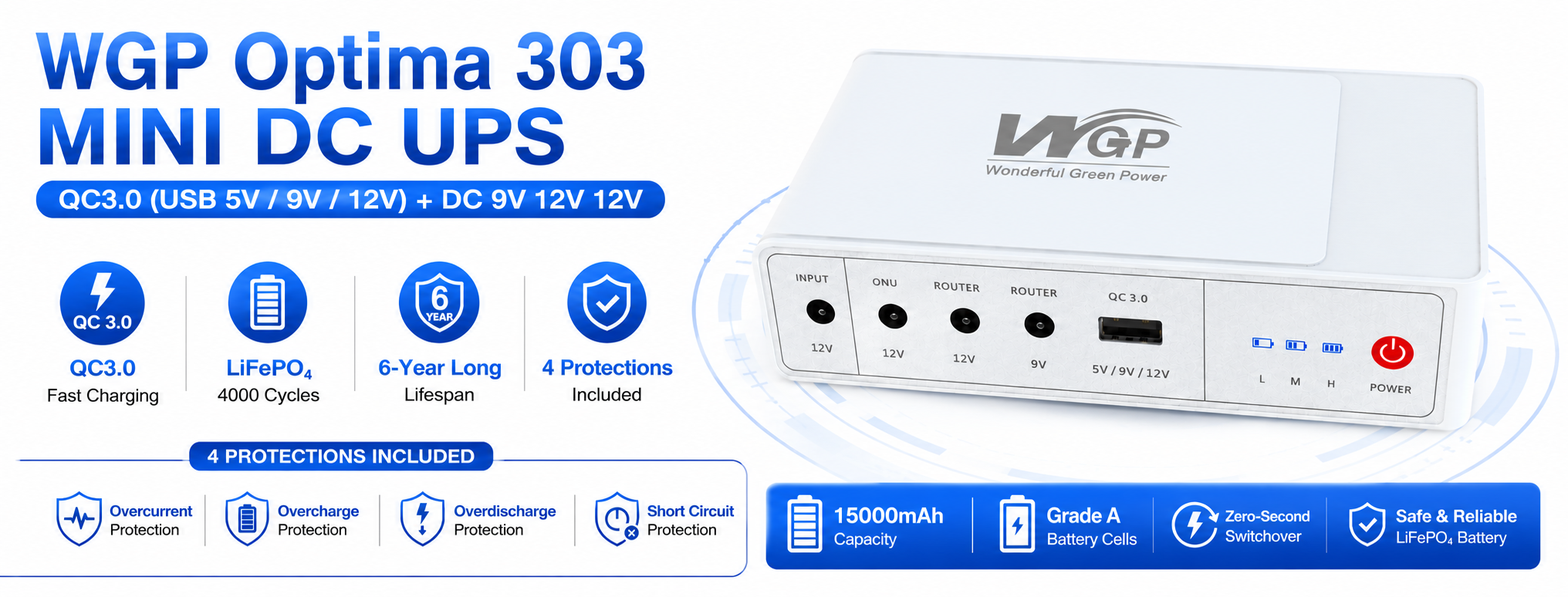
To meet the global market’s demand for safe, durable and multi-functional standby power, WGP launches the upgraded Optima 303 LiFePO4 Mini UPS. Equipped with a 15000mAh high-capacity genuine lithium iron phosphate battery, it supports 18W max output and standard DC 12V input. With four flexible output modes and built-in QC 3.0 fast charging technology, it breaks the single-function limitation of traditional mini UPS, realizing stable device power supply and daily fast charging simultaneously.
Professional-grade output configuration, adaptable to diverse scenario requirements:
It provides professional-grade output configurations including DC 12V1.5A and 9V1A fixed ports, plus adaptive USB output of 5V3A, 9V2A and 12V1.5A. It works perfectly as a dedicated LiFePO4 Mini UPS for WiFi router and CCTV camera, steadily powering 9V/12V ONU devices, home routers and surveillance cameras during power failures. Meanwhile, the QC 3.0 fast charging function supports quick charging of smartphones and tablets, realizing multi-scenario one-device multi-purpose use.
Summary—The top choice for long-lasting backup power for home networks and security systems:
Ideal for home users, remote workers and small security integrators, WGP Optima 303 perfectly balances safety, durability and compatibility. With ultra-long cycle life, full safety protection and wide device adaptability, it thoroughly solves the shortcomings of short lifespan and poor stability of traditional mini UPS, becoming a premium long-term standby power solution for home networking, smart home systems and small-scale monitoring projects.
Post time: Aug-04-2026


